A
problem adequately stated is a problem well on its way to being solved. --R. Buckminster Fuller
|
|
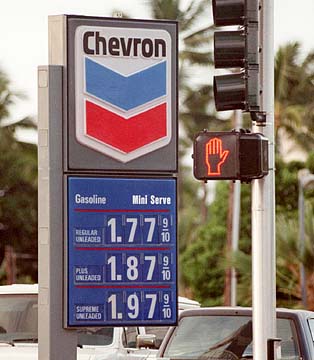
�Court documents filed show that Chevron
� sold only 3 percent of its
national
� gasoline in Hawai�i,
� yet 23 percent of its U.S.
profits
�were generated here.� -- Star Bulletin Jan. 20, 2002
�I propose a business solution - The State of Hawai�i
establish a publicly owned, non-profit entity known as The Hawai�i Fuel
Authority. We must NOW, today, make a commitment to democratic government for
the common good of our citizens. We must have a voice and we must demand
involvement. We can no longer allow outside influences to dictate our future.�
--D.G. �Andy� Anderson
CALENDAR
YEAR � 2001
HAWAI�I� 12 - Month �Overcharge� For Gasoline
�����������������
410 �.million gallons gasoline sold
�x ����������$ 0.40 � per
gallon
�overcharge.� (Compared with the average mainland prices.)�
������
��� $ 164 million dollars
�overcharge / difference.�
Note: State anti-trust attorney, Spencer Hosie in
presentation to the legislature reported, �that��������������
���������
the local oil companies reaped huge profits of 50 to 60 cents a
gallon�. (4.04.2002)
��������� $ 205,500,000�..@ 50 cents.
��������� $
246,600,000�..@ 60 cents.
Plus�.
HAWAI�I� 12 - Month �Overcharge� For Diesel Fuel
Off -
Highway and On - Highway
��� The sale of
over-priced diesel fuel has been ignored to date. It is yet another example of
over-
��� charging that comes directly from our
pockets and contributes to our high cost of living.
����������������� 213 �million gallons Diesel Fuel
sold.
�x� �����������$ .30 �per
gallon �overcharge.� (Compared with the average mainland prices.)
���� $ 64 million dollars �overcharge
/ difference.�
Source for gallons sold: State DOT Comparison of Fuel Tax
Collections & Allocation
TOTAL �Difference /
Overcharge� to the People of Hawai�i in 2001.
$ 228 Million
�
taken out of Hawai�i last year (and every year)
Where do you
live, Honolulu, Maui, Big Island or Kauai?
� ��How many cars
do you have ?
�
��How much are you paying for gasoline a week,
a month ?
� ��Are you in
construction ?
� ��Do you
operate a bus company ?
� ��Do you own a
fishing boat or pleasure craft ?
� ��Maybe you
drive a new car that uses diesel fuel ?
� ��How much do
you pay for your diesel fuel a week, a month ?
� ��How much do
you have to pay per gallon ?
� ��Are you
paying too much ?
TRUTH IS, ALL OF US ARE, AND HAVE BEEN
PAYING TOO MUCH.
It�s
simple mathematics. Take the number of gallons of gasoline or diesel fuel you
buy and �deduct� 40 cents per gallon from the retail price.
Example:
Just 20 gallons x .40 = $8.00 �over-charge.�
Here are examples of what we �CAN PAY� and/or �SHOULD HAVE PAID� (+/-) if we had/have our own publicly owned, non-profit
Hawai�i Fuel Authority.
Unleaded regular gasoline:
OAHU���������������.��$ 1.34�
a gallon.
HAWAI�I (Big Island) ���������...$ 1.39� a gallon.
MAUI������������������$ 1.43�
a gallon.
KAUAI�����������������$ 1.39�
a gallon.
All of the above prices include the �existing�
Federal, State and County taxes.
All we have to do,
is do it.��������
�����������������������������������������������������������������
The Hawaii Fuel Authority
A publicly-owned,
non-profit Authority.
Objectives:
- To
deliver gasoline and diesel fuel to Hawai�i�s residents at prices
comparable to the rest of the country.
- To
keep at home in Hawai�i the estimated $225 million dollar �over charge�
that flows out of the state every year.
- To
demonstrate and send a clear message once and for all that the people of
����������� Hawai�i, while a tolerant people, will no longer accept unfair treatment by
�������������� national companies,
or for that matter any abusive oligopolistic company.
Introduction
and Overview:��������������������
�������������������������������������������������������������������������������������������������
An Ownership
Strategy for Stability����
A problem adequately stated is a problem well on its
way to
being solved. --R. Buckminster Fuller
Court documents revealed that Chevron sold only 3 percent of its
national gasoline in Hawai�i, yet 23 percent of its U.S. profits were generated
here.
We have, more
times than I can remember, gone down the road of trying to understand and
control our runaway gasoline prices paid for so many years. We have, on more
than one occasion, introduced legislation and/or threatened State action
through the Attorney General�s office. Three years ago, the State actually
filed its price-fixing suit against the oil companies in an effort to prove
that they were conspiring, from 1991 to 1998, to fix gasoline prices and
allocate market share amongst themselves, in violation of U.S. antitrust laws.
We had visions of winning some
two billion dollars in settlements against the oil cartel. We settled for a
pittance of some twenty-two million dollars, a mere penny on the dollar.
Hawai�i has not been able to prevail in anti-trust law suits brought against
the likes of Chevron and the other related oil cartel members. Although Hawai�i
has a valid case, the cartel members are just too large an international
conglomerate and far too complex in their multiple levels of corporate
structure and business relations to prove the price-fixing allegation.
It is not my position to continue to accuse Chevron or the others in the cartel of operating illegally. I do not intend to bring further litigation on this issue. What is important, is that what is in place, is not functioning to the benefit of the people of Hawai�i, and I plan to change that.
I propose that we
in Hawaii develop an independent source of fuel, which can compete with the oil
companies now selling in the Hawai�i market.�
In the following sections I will present the details of my plan.� In essence, it is an independent Authority
to be established by statute that will import refined fuel (gasoline and
diesel) from domestic and international sources and make them available through
independent gas stations to serve the general public.� We will show that the Authority�s price will be substantially
lower than prices historically charged by the oil companies.� In other words, we propose to squeeze the
unconscionable profits now being made by the oil companies to a reasonable
level and pass on the savings to the people of Hawai�i where they belong.
In the following
pages I will present the facts and figures and the steps we need to take to
stop the oil companies from milking the citizens of Hawaii out of $225 million
annually, the money the oil companies are making from their price gouging; the
money they are taking out of Hawai'i: the money they are taking out of our
pockets. Don�t get me wrong.� The oil
companies are entitled to a fair profit, comparable to what they make in the
rest of the country. Hawaii represents 3% of Chevron�s gasoline and diesel
business nationwide; the profits made in Hawaii should be comparable, not
23% of the total profit Chevron earns nationwide for the same commodities and
operations.
I am proposing a business concept that is not new and
today is in operation in Hawai�i.� A jet
fuel consortium organized by the airline industry has long been successful in
obtaining jet fuel in Hawai�i at prices comparable to mainland prices.� It is in business today for the very same
reason this proposal is being offered, to bring to an end the abuse and
overcharging by the Chevron�s of the world.�
This will be a new path for us, a daring one, but it can
be exciting with rewards and benefits to our State like nothing we have ever
attempted. This opportunity comes along once in a lifetime and we would be
foolish to not use it to our best advantage and to our benefit. Our State is in
an economic slump as never before. We cannot pay our bills today, and we have
no idea how we will meet these obligations next year and thereafter. Can you imagine what $225 million a year
would have done for our economy over the last 10 years of the business
slowdown?� Ladies and gentlemen, that is
$2.25 BILLION dollars over the 10-year span.
A $225 million annual savings that never leaves a
citizens� wallet and instead is spent in the private economy would be a
tremendous economic stimulus in itself. Couple this with a multiplier of 2.5/
3.0 times for the money that stays in the State and circulates, and it would
kick-start our economy without question, as well as go a long way in reducing
our high cost of living. If we are successful, there is nothing in the next
decade that would equal or give us an economic boost more quickly and certainly
than this proposal. Our ability then to financially rebound and begin to fund
our educational institutions and social programs would receive an almost
immediate shot in the arm after the plan is implemented.
It is
an opportunity for economic recovery like nothing I have ever seen in all of my
years in government and/or private business. The savings proposed herein is a
savings that is broad based and effect all segments of our community, enjoyed
by both governments and the public alike. It is a savings that will be demonstrated
and enjoyed daily in our lives versus the once in a year tax refund that we are
used to.
We began work on this proposal months ago in anticipation of the State not prevailing in court. The outcome was not unexpected. While our approach differs in how to correct this historical inequity, we are in full agreement with the Cayetano administration that the oil companies have long abused the trust of the people of Hawai�i.
The cost of living is just too high in Hawai�i and it will never come down if we do not take the initiative to effect change. If we want our children to stop leaving Hawai�i for Las Vegas, Portland and other parts of the world, seeking a place they can afford to live, buying a home and raising their young: if we want our young to return home from school to new and exciting job opportunities, we have to make it happen. My proposal is only the first step to bring down the cost of living in Hawai�i, but is a positive step in the right direction.
Just hoping and waiting for it to happen is just not realistic. There are just too many �unfair situations� in Hawai�i that deny us a chance to enjoy the rewards for our hard work with many of us having to hold two and even sometimes three jobs to live in �paradise.� It is time to understand, plan, and participate in our own future and destiny. I believe this proposal will begin the long road back to economic recovery and self-determination.
I ask you to join with me to make this happen. It�s an exciting and once in a lifetime opportunity, we cannot let it elude us. We must take advantage of it now or forever lose it.
As a footnote I would like to make the reader aware that while most of the discussion to date has been centered on gasoline, the abuse and overcharging applies to our purchase of diesel fuel as well. This also impacts our high cost of living in almost every thing we do every day.
Aloha Ola,
andy
Hawai�i�s Problem ��
Jan. 20, 2002�
Honolulu Star-Bulletin Editorial
http://starbulletin.com/
The Issue:
�The state government has settled for $20 million in their lawsuit alleging price-fixing by
� oil companies that serve Hawai�i.
�The state�s effort could be counted as worthwhile if legislators and the administration examine the companies� court filings for whatever information can be gleaned. They should press for continuing access to company records to prevent a recurrence of the rip-off. However, Attorney General Earl Anzai says the state will probably stop investigating and lawmakers have not suggested they will pick it up.
�With the settlement, the allegation of price-fixing by the oil companies may never be determined. What is clear is that Hawai�i has been a profitable market for gasoline producers.
�Court documents filed showed that:
�Chevron sold only 3 percent of its national gasoline volume
� in Hawai�i, yet 23 percent
of its U. S. profits
� were generated here.
�Fair or not, producers will charge what the market will
bear. No number of lawsuits will change the limitations geography places on a
captive market. So electing to buy the cheapest gas
they can find remains the consumers only choice.� (Emphasis added.)
I agree with this conclusion.
However, I do not have to agree, nor do I accept that Hawai�i and her people must remain captive to the continued abuse, be it a monopoly and/or an oligopolistic arrangement of the gasoline producers in Hawai�i. It is no wonder that Hawai�i�s cost of living is off the charts and our young are fleeing to the mainland to make ends meet.
Recognizing
that Hawai�i is a unique state separated by 2,500 miles
of ocean to the West coast, we are often exposed to unique and difficult
problems as to our cost of living that today demand unique solutions.
Today,
I am pleased to propose a unique business and creative solution, an alternative
that will indeed offer our people a choice �to
buy the cheapest gas they can find.�
���������������������������������������������������������������������������
The Andy 2002 Campaign Proposal:
The Hawai�i Fuel Authority�
(HFA)
A publicly-owned, non-profit
Authority.
GOAL: TO KEEP IN HAWAI�I
An annual savings to Hawai�i�s people in the amount of an estimated
$225 million dollars.�
A $225 million dollar
annual savings infused into the private economy would be a tremendous economic
stimulus in itself. Couple this with an economic multiplier of 2.5 to 3.0
times, and it would kick- start our economy without question, AND go a long way
in reducing our high cost of living.
Note: It is not the intention of the Hawai�i Fuel Authority (HFA)
to capture the market 100%. We fully
understand that this is not feasible and while we use a $225 million
figure in our calculations, we are comfortable in that any thing less than 100%
will still provide the savings to the consumer as the competition will drive
down the �others� prices�thus the �overall� estimated savings will and can be
calculated as projected.
Objectives:
- To
deliver gasoline and diesel fuel to Hawai�i�s residents at prices
comparable to the rest of the country. The daily savings would be
immediate as we buy our gasoline and diesel for our everyday use. This
savings would be distributed and enjoyed across a wide spectrum of our
state. The general consumer, businesses, the bus rider, the car rental
business, the farmer, the fisherman and the state and county governments
as well.
- To
keep at home in Hawai'i the reported and estimated $225 million dollars
overcharge (see details in exhibits) for fuel that flows to the mainland
corporate profit sheets. We must retain these Hawai�i dollars in Hawai�i
to contribute to our sagging economy, assist in our economic recovery, and
ultimately reduce our cost of living.
- And
finally to make a statement once and for all that the people of Hawai�i,
while� fair and tolerant, will no
longer passively accept unfairness from the national companies, or for
that matter any monopolistic and/or oligopolistic abusing companies. We
will here and forever take back control of our lives and futures.
PROPOSAL:
Create a publicly owned non-profit company, The Hawai�i
Fuel Authority (HFA) to:
�
First, enable the HFA to import, sell, store and
utilize gasoline and diesel fuels bought
����� on the spot market, and;
�
Second, allow the state to sell gasoline and diesel
fuels to the public directly and/or the
����� private sector for public consumption.
IMPLEMENTATION:
We must introduce a
comprehensive package of legislation. I have outlined a business concept that
will accomplish what I am planning to do. As we proceed, I would invite public
and private input and ultimately that of the State Legislature.
ENABLING LEGISLATION:
Pass legislation to create the publicly owned non-profit
Hawai�i Fuel Authority (HFA).
The law would allow the State to build/acquire storage and
distribution facilities on all islands providing all governments, residents and
businesses of Hawai�i the option to purchase assorted fuels (gasoline and diesel)
at Hawai�i Fuel Authority (HFA) outlets and other various independent outlets
who choose to purchase from the Authority AND;
����
Authorize the Hawai�i Fuel Authority to build, own, and/or lease its
own stations for the purpose of selling gasoline and diesel throughout the
state when it determines the market does not adequately provide reasonably
priced fuel for local citizens. These Authority owned stations/outlets, should
they be developed, would sell fuel at prices that would allow a fair return
for the independent operators. It is not intended to dominate the market but to
bring stability to it.
���
Authorize the Authority/State to acquire an existing fuel distribution
company if available-and if a mutual arrangement can be worked out for both
parties. This would allow the program an almost immediate start.
��� Establish the
Hawai�i Fuel Authority (HFA) as an independent body removed from government
control and interference in its operations. Its employees would not be civil
service. It is envisioned to be an independent, business-like non-profit
Authority governed by its own board of directors. The Authority would be obligated to be financially self-sufficient and
to meet any debt service requirements for revenue bonds issued by the State on
its behalf. Note: In the long term, after the facilities are developed and the
operation stabilized, it might be more advantageous to convert the Authority to
a private not-for-profit corporation, if it is deemed to be in the best
interest of the public.
SPECIAL REVENUE
BOND AUTHORIZATION:
At the outset, we must determine the storage tank and
distribution system requirements and distribution system costs on all islands.
These Capital Improvement (CIP) costs will be financed by the sale of Special
Revenue Bonds. The debt on these bonds will be paid for by the sale of gasoline
and diesel fuel by the Authority. (The debt service dollars required for the
pay down of the capital improvements are contained in the calculation example
below.)(It is my understanding that the State of Hawai�i presently owns some
storage facilities sitting empty on the waterfront. (TBD)
CREATE A LOAN GUARANTEE PROGRAM FOR THE
CREATION OF INDEPENDENT PRIVATE (SERVICE) STATION OPERATORS:
It is equally important to include in the legislation authority
for the Authority to create a loan program for independent (service) station
operators enabling them to build, buy and own and operate their own stations.
These loans would be processed, evaluated and approved based on their business
plans as submitted. The Authority would guarantee the loans to the lender BUT
the actual loan and collections and responsibility for the note (s) will be
that of the lender. It is not my intention to further expand the states efforts
into the loan business, as our record for collections to delinquencies is
rather dismal.
REPEAL EXISTING
LAW OF 1997, ACT 257:
Despite the passage of a 1997 state law that was intended to protect Hawai�i�s gasoline retail dealers from being replaced by stations owned and operated by oil companies, approximately 30 dealers have shut down since, according to the Hawai�i� Automotive Repair and Gasoline Dealers Association. Repeal of this Act would�
� Allow the producers to buy back and/or build new stations thus allowing them to better
����� compete with the Hawai�i Fuel Authority (HFA) on a more even playing field.
� Allow the lessees of the existing stations to exit their �locked in� positions and allow
����� them to apply for their own independently-owned station with the Authority.
������������� �(Note: Act 257 was �again� declared unconstitutional on March 28,
2002 by U.S. Judge Mollway.)
LEGISLATION
PERTAINING TO NEW GOVERNMENT FUEL TAXES:
We would support legislation that would require a two-thirds majority vote by the State Legislature and all of the various County Councils to increase/impose any new future fuel taxes within their jurisdiction. As the prices would be lower by comparison to our historical past, the temptation of the politician to �edge it up� a few cents at a time would be most tempting to pay for pet projects. This would defeat the purpose and intent of the Hawai�i Fuel Authority, and it should be made difficult to increase these government taxes.
CREATION OF AN ALTERNATIVE ENERGY FUND (AEF):
Legislation would be passed creating an Alternative Energy Fund (AEF). It is my intent to include within the Hawai�i Fuel Authority�s wholesale price for all its fuels a one-cent per gallon amount for this �new� Alternative Energy Fund (AEF). As I am asking Hawai�i to look forward and down the road ten years to economic diversification, I believe it consistent for us to also be concerned now with this fast arriving issue of alternative energy. It is our future.
FACTS/VERIFICATION OF EXISTING PROGRAMS:
Some
will say, �It can�t be done.� I say, � It can be done, and is already being
done. Hawai�i has a successful business consortium in operation similar to this
proposal. I have done no more than to adapt this �creative business concept�--
and amend it to the advantage of the people of Hawai�i -- so they can indeed,
�shop for better prices for gasoline and diesel fuel.�
Hawai�i Fueling Facilities Corporation.
(HFFC)
(Formerly the Honolulu Fueling Facilities Corp.)
�Created November 8, 1990
The
stated initial purpose for the HFFC was two fold. First to ensure adequate
supplies of jet fuel in a supply emergency: second, to enable the member
airlines to import, store and utilize jet fuel cargoes bought by them on the
�spot market� at prices lower than those offered by oil company suppliers in
Hawai�i.
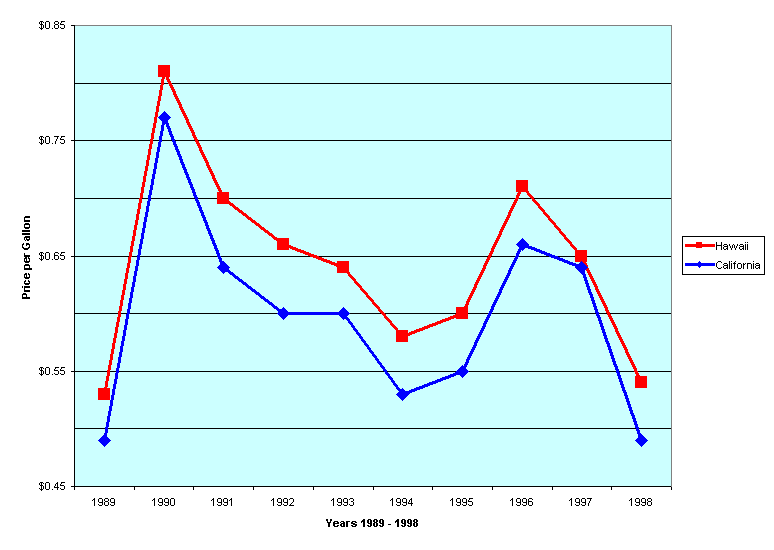
Compare the
below chart. This is the success story of the Hawai'i Fueling Facilities
Corporation since its inception. The cost between California and Hawai'i�s
price for jet fuel is just 5 cents (+/-).
EXHIBIT:� 1
��� Retail Prices in Hawai'i and California
Jet Fuel 1989 � 1998
 �
�
��� Now compare this chart for the difference between
� Hawai'i Average price per gallon of gasoline
vs. the
� National Average cost for that same gallon
of gasoline.
�� Year 2001.���� More like 40 cents a gallon.
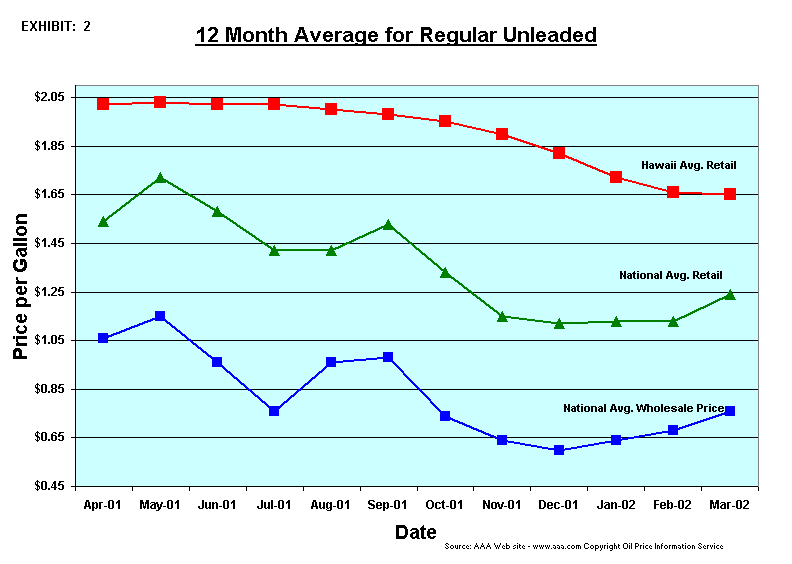
EXHIBIT:
3
Hawai'i Fuel
Authority
Total Estimated Fuel Cost and Selling Price of Gasoline
|
|
|
|
|
|
|||||||||||
|
|
|
|
|
|
|
|
|
|
|
||||||
|
|
$1.34 |
|
|
|
|
|
|
|
|
||||||
|
|
|
���� Total
Cost per Gallon |
|
|
|
||||||||||
|
|
|
|
|
|
|
|
|
|
|
||||||
|
|
.01 |
���� Alternative Energy Fund Contribution
(AEF) New |
|
|
|||||||||||
|
|
.55 |
���� Federal, State County Taxes (Used
Honolulu as it's the highest) Existing |
|||||||||||||
|
|
.09 |
���� Station Owner's Operating Margin |
|
|
|
|
|||||||||
|
|
.04 |
���� Operations and Delivery |
|
|
|
|
|
||||||||
|
|
.03 |
���� Storage and Debt Service |
|
|
|
|
|
||||||||
|
|
.06 |
���� Shipping and importation |
|
|
|
|
|
||||||||
|
|
.56 |
���� Avg. Cost of Regular Unleaded Gasoline
on the Spot Market (2001) |
|
||||||||||||
|
|
|
|
|
|
|
|
|
|
|
||||||


EXHIBIT: 4��������
ESTIMATED COST PER GALLON OF UNLEADED�
������������������������������ GASOLINE BY COUNTY � AND SELLING
PRICE.
|
Cost to Import, Store,
Miscellaneous Costs and Selling Prices. |
|||||
|
|
|
|
|
|
|
|
|
|
|
RETAIL
PRICES OF IMPORTED REGULAR GASOLINE |
|
|
|
|
|
|
Year
2001 |
|
|
|
|
|
|
(Hawai'i
Fuel Authority example) |
|
|
|
|
|
|
|
|
|
|
|
|
|
Cost of Tanker Load: |
Per
Gallon |
|
|
|
|
|
|
|
|
|
|
|
|
�Unleaded Regular Gasoline on "Spot
Market" |
$0.56 |
|
|
|
|
|
�Shipping |
$0.06 |
|
|
|
|
|
�Storage and Debt Service |
$0.03 |
|
|
|
|
|
�Operations |
$0.02 |
|
|
|
|
|
�Delivery |
$0.02 |
|
|
|
|
|
�Alternative Energy Fund (AEF)
Contribution� �New� |
$0.01 |
|
|
|
|
|
�Station Operating Margin |
$0.09 |
|
|
|
|
|
���������������
�������������������������������������������Base Cost Per Gallon |
$0.79 |
|
|
|
|
|
|
|
|
|
|
|
|
����������������������� Base Cost Plus the
County Add On. |
|
|
|
|
|
|
|
|
|
|
|
|
|
Honolulu� Retail |
|
|
|
|
|
|
�Taxes�
(Includes all existing) |
$0.55 |
|
|
|
|
|
����������������������������������� ����������������������Retail Price Per Gallon |
$1.34 |
|
|
|
|
|
|
|
|
|
|
|
|
Hilo Retail |
|
|
|
|
|
|
�Trans - shipment To Hilo |
$0.06 |
|
|
|
|
|
�Storage |
$0.04 |
|
|
|
|
|
�Add Operation-Delivery Costs |
$0.02 |
|
|
|
|
|
�Taxes��
(Includes all existing) |
$0.48 |
|
|
|
|
|
��������������������������� ������������������������������Retail Price Per Gallon |
$1.39 |
|
|
|
|
|
|
|
|
|
|
|
|
Maui Retail |
|
|
|
|
|
|
�Trans - shipment to Maui |
$0.06 |
|
|
|
|
|
�Storage |
$0.04 |
|
|
|
|
|
�Add Operations-Delivery Costs |
$0.02 |
|
|
|
|
|
�Taxes�
(Includes all existing) |
$0.52 |
|
|
|
|
|
������������������� ��������������������������������������Retail Price Per Gallon |
$1.43 |
|
|
|
|
|
|
|
|
|
|
|
|
Kauai Retail |
|
|
|
|
|
|
�Trans - shipment to Kauai |
$0.06 |
|
|
|
|
|
�Storage |
$0.04 |
|
|
|
|
|
�Add Operations-Delivery Costs |
$0.02 |
|
|
|
|
|
�Taxes��
(Includes all existing) |
$0.48 |
|
|
|
|
|
��������
�������������������������������������������������Retail Price Per
Gallon |
$1.39 |
|
|
|
|
|
A:\Gaso-Import |
|
|
EXHIBIT:� 5 �����
������������������������ FEDERAL, STATE &
COUNTY
��������������� FUEL TAXES PER GALLON OF GASOLINE:
�������������������� (
Identical State/County taxes apply to Highway Diesel. )�
|
January
1, 2002 |
|
|
Schedule
of tax rates per gallon. |
|
|
�Federal, State & County Taxes by
County: |
|
|
|
|
|
���� City & County Of Honolulu Fuel Tax |
0.1650 |
|
������������������������������������������
State Fuel Tax |
0.1612 |
|
��������������������������������������
Federal Fuel Tax |
0.1840 |
|
���������������������������������������������
Total Taxes |
����������������� 0.5102 |
|
|
|
|
������������������������ Hawai'i County Fuel
Tax |
0.0880 |
|
���������������������������������� ���������State Fuel Tax |
0.1612 |
|
���������������������������������������
Federal Fuel Tax |
0.1840 |
|
����������������������������������������������
Total Taxes |
����������������� 0.4332 |
|
|
|
|
����������������������������� Maui County
Fuel Tax |
0.1300 |
|
��������� ����������������������������������State Fuel Tax |
0.1612 |
|
���������������������������������������
Federal Fuel Tax |
0.1840 |
|
����������������������������������������������
Total Taxes |
����������������� 0.4752 |
|
|
|
|
��������������������������� Kauai County Fuel
Tax |
0.1000 |
|
�������������������������������������������
State Fuel Tax |
0.1612 |
|
���������������������������������������
Federal Fuel Tax |
0.1840 |
|
����������������������������������������������
Total Taxes |
����������������� 0.4452 |
Note: Federal, State, and local taxes are a large component of the retail price of gasoline. Taxes (not including county and local taxes) account for approximately 28 percent of the cost of a gallon of gasoline. Within this national average, Federal highway taxes are 18.4 cents per gallon and State taxes average about 20 cents per gallon. Also, some States levy additional State taxes, some of which are applied to the Federal and State taxes.
(Hawai�i is such a state in that it charges additionally the
4% G.E.T. tax on the total amount including the taxes.) The G.E.T. tax IS NOT in the above totals.
|
|
|
|
EXHIBIT:� 6
GASOLINE & DIESEL FUEL CONSUMPTION IN HAWAI�I
IN
MILLIONS OF GALLONS (BY COUNTY):
|
���� �� |
������ LIQUID FUEL TAX BASE, BY COUNTIES:
2001 |
|
|||
|
Annual
totals accordingly refer to fuel sold during a 12-month period ending
November 30. |
|||||
|
|
|
|
|
|
|
|
|
|
|
|
|
|
|
|
|
|
City & County of |
County of |
County of |
|
Type of fuel |
State total |
|
Honolulu |
Maui |
Hawaii |
|
|
|
|
|
|
|
|
Total |
622,983,593 |
|
405,938,945 |
86,316,958 |
93,968,526 |
|
|
|
|
|
|
|
|
Gasoline |
409,909,642 |
|
264,460,672 |
56,585,452 |
64,633,896 |
|
Diesel
oil, Non-Hwy. |
179,000,080 |
|
121,126,217 |
25,580,306 |
21,396,888 |
|
Diesel
oil Hwy. Use. |
34,018,020 |
|
20,336,582 |
4,151,200 |
7,897,365 |
|
Small
boats, gasoline. |
8,823 |
|
8,823 |
0 |
0 |
|
Small
boats, diesel |
47,028 |
|
6,651 |
0 |
40,377 |
|
|
|
|
|
|
|
|
Source:
Hawai'i State Department of Taxation, Liquid Fuel Tax Base and Tax
Collections. |
|||||
|
|
|
|
|
|
|
|
|
|
|
|
|
|
|
One
barrel equals 42 gallons. One shipload is 150,000 barrels. |
|
|
|||
|
|
|
|
|
|
|
|
|
|
|
|
|
|
|
|
Gallons of Gasoline |
|
Annual Ship loads |
Gallons of Diesel |
Annual Ship loads |
|
|
Millions |
|
Gasoline |
Millions |
Diesel |
|
|
|
|
|
|
|
|
State of
Hawai'i |
409,965,493 |
|
65 |
213,018,100 |
34 |
|
|
|
|
|
|
|
Note: This is to demonstrate the
approximate number of shiploads to Hawai'i on an annual basis.
�It
will vary as we incorporate and breakdown the ships as to types of fuel.
SUMMARY
The
proposal I have outlined above is founded on the idea that Hawai�i deserves to
enjoy the fruits of free and open competition in meeting its demand for
gasoline and diesel fuels, a condition which does not exist today.� The problem is not at the retail level; it
is at the wholesale supply level.� The
only way that the price differential between Hawai�i and the mainland can be
explained is that Hawai�i is a captive market victimized by the greed of the
oil companies.
My plan
focuses on the nub of the problem, and uses the power granted to its government
by the people of Hawai�i to solve the problem.�
The Hawai�i Fuel Authority will provide competition to the oil companies
by entering into the market place to import gasoline and diesel products from
domestic and international sources and supplying the retail gasoline stations
with product that is priced to recover the Authority�s costs, including the
cost of capital.� What will be left out
of the price structure will be the excess profit �over and above� the normal
profit that the oil companies enjoy on their mainland sales.
I am
mindful that government operations are not well suited for the competitive
business world.� The Authority will have
to operate like a business, run by business people who know the business, free
from bureaucratic control.� The
legislative package I propose is designed to provide the necessary tools to
bring success to this vital venture.�
Like a
business, the Authority will have to satisfy the customers and pay its
expenses.� We expect fierce competition
from the entrenched oil companies, which will be good for the paying customers
and good for Hawai�i�s economy.
Because
the problem is not caused by the gasoline and diesel retail dealers, we do not
attempt to curtail or control their activities.� On the contrary, we encourage and intend to assist independent
dealers and stations in providing the needs of their customers, the
driving� public of Hawai�i.� If necessary, the Authority will enter into
the retail market itself to assure the availability of gas and diesel priced at
a level designed to provide a reasonable profit to the retail gas dealers.�
The financial and economic benefits of this program to the
people of Hawai�i are significant.� Our
projections are based on conservative estimates of costs to the Authority which
must be passed on to the customers, like any other business.� Other than providing capital for
improvements and startup costs, which will be repaid over time, the Authority
will be self-supporting financially and be free of politics.�
�