|
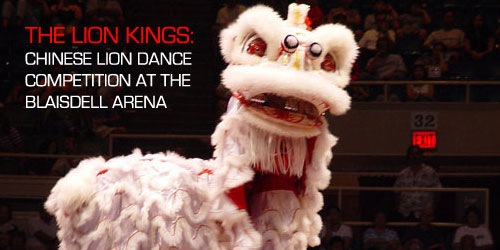
 The ancient
art of Chinese lion dance has survived through many generations. Evolving
from a simple ritual used to chase away evil spirits and bring good
fortunes not long ago, it has developed into a sport seen around the word.
This past October, Hawaii was treated to one of these exhibitions and
competitions, attracting teams from across the Pacific Rim to the First
Annual Lion Kings Competition at the Neal Blaisdell Center. This new breed
of Chinese lions are no longer associated simply with looking frightening
and linked to firecrackers, it is now also looked upon as a cute, furry,
and defines what people can achieve when your mind is set to it The ancient
art of Chinese lion dance has survived through many generations. Evolving
from a simple ritual used to chase away evil spirits and bring good
fortunes not long ago, it has developed into a sport seen around the word.
This past October, Hawaii was treated to one of these exhibitions and
competitions, attracting teams from across the Pacific Rim to the First
Annual Lion Kings Competition at the Neal Blaisdell Center. This new breed
of Chinese lions are no longer associated simply with looking frightening
and linked to firecrackers, it is now also looked upon as a cute, furry,
and defines what people can achieve when your mind is set to it
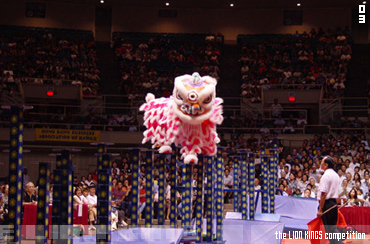
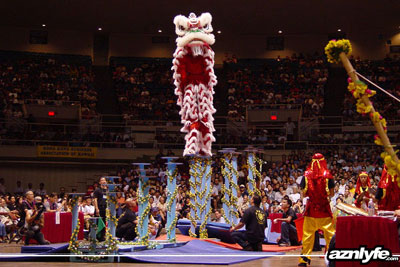
This sport of Jong (pole) jumping has developed within the past decade in
China. With the team consisting of six instruments, one head, and one tail
player, the team tries to portray a lion climbing the mountain the best
they can. The goal of each routine is to tell a story of the lion climbing
up a mountain searching for the flower of immortality. Upon finding the
flower of immortality, the lion eats it, but soon feels remorseful and
spits it out. With the poles representing the mountain, ranging from 3 to
9 ft high, it leaps its way up till it reaches the flower. While on
jumping up and down the mountain, the lion’s characteristics of happiness,
excitement, and fright are portrayed as any real animal would. Acrobatic
movements can be seen on poles high and low, all on plates only 12 inches
wide.
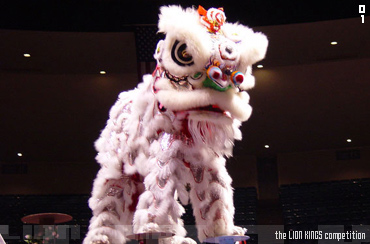 Like the
similar sport of figure skating, this sport is judged on character (best
portrayal of a lion), difficulty and completion of tricks, and
synchronization of the drum and lion. A panel of judges score the teams,
and the scores’ average is compiled. Like the
similar sport of figure skating, this sport is judged on character (best
portrayal of a lion), difficulty and completion of tricks, and
synchronization of the drum and lion. A panel of judges score the teams,
and the scores’ average is compiled.
With the explosion of enthusiasm toward this new sport, it has reached
countries as far as the Netherlands, Canada, and even Hawaii with the Lion
Kings Competition. Generally stemming from Asia, teams such as China, Hong
Kong, and Malaysia have already established a name for themselves in this
newly developed sport. Even teams in the United States are building their
reputation.
For the
Lion Kings Competition, Hawaii's Chinese Lion Dance Association was proud
enough to invite and host several championship teams from each country to
compete for a cash prize of $10,000. In future competitions, this field
may expand to include even more competing teams from a broader geography.
Coming out on top was the team from Hong Kong, second Taiwan, and third
San Francisco. At an extremely close fourth was the Chinese Lion Dance
Association team from Hawaii. Taking tops in Hawaii and following so
closely behind other international teams, the Chinese Lion Dance
Association says, “Just knowing that Hawaii can compete at a world class
level is exciting.”
 Seeing how this sport is still in its infant stages, it has great
potential to become a sport for the ages. The enthusiasm encountered in
the Blaisdell Arena has prompted this past tournament to be an annual
event. If you did not get to check out this past tournament, make sure you
make it out next time because it’s guaranteed to be even better. Seeing how this sport is still in its infant stages, it has great
potential to become a sport for the ages. The enthusiasm encountered in
the Blaisdell Arena has prompted this past tournament to be an annual
event. If you did not get to check out this past tournament, make sure you
make it out next time because it’s guaranteed to be even better.
Article by: Victor Wong, Khai Tran (ed.)
Photos by: Khai Tran
If you would like to preorder the upcoming DVD of the
Lion Kings Competition, click
here, or email us at
info@aznlyfe.com for more information. For a preview of what's in
store, check out the
trailer (3.5MB, Windows Media Player required).
|